
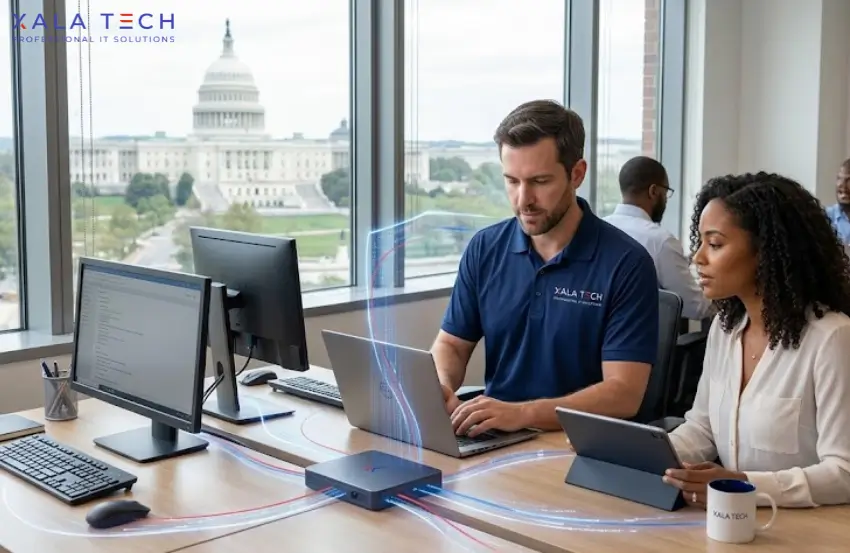
Washington DC businesses increasingly depend on cloud applications, business networks, email, remote access, and connected devices, making strong network security essential. Weak protection can expose organizations to cybersecurity threats and vulnerabilities, including unauthorized access, phishing, malware, ransomware, and data loss. Three key challenges are cybersecurity vulnerabilities, limited continuous security monitoring, and effective security and compliance management. A single weakness can disrupt operations, expose customer data, compromise employee accounts, or affect business continuity.
Stronger protection requires more than installing a firewall. Businesses should use a layered strategy that includes firewalls, endpoint security, MFA, patch management, network monitoring, secure Wi-Fi, access controls, backups, and employee awareness. Combining preventive controls with continuous detection and response helps businesses identify suspicious activity earlier, protect sensitive information, and maintain a more resilient business network.
Phishing attacks often use convincing emails or fake login pages to trick employees into revealing business credentials. Compromised Microsoft 365 and cloud accounts can provide attackers with access to email, files, and other connected services, potentially affecting the wider business network.
Malicious software can disrupt systems and prevent employees from accessing important business data. Endpoint protection, reliable backups, and network segmentation can help limit the impact if malware reaches one device or part of the network.
Outdated operating systems, applications, routers, firewalls, and firmware can contain exploitable weaknesses. Regular patch management helps reduce these risks and keeps network infrastructure better protected.
Weak Wi-Fi passwords, poorly configured wireless networks, and unsecured remote connections can create entry points into business systems. Strong authentication, properly configured wireless security, and secure VPN access where appropriate can help reduce exposure. A weakness in one area can affect connected systems across the wider network.

Businesses should regularly review their environment for outdated software, exposed services, weak configurations, and unauthorized devices. Scheduled vulnerability assessments can identify weaknesses before attackers exploit them and are more useful than relying on a single security check.
A properly configured next-generation firewall can control network traffic and help block suspicious activity. Businesses should regularly review firewall rules, secure configurations, and network segmentation to limit unnecessary access between systems.
Laptops, desktops, servers, mobile devices, and other connected equipment should have appropriate security controls. Endpoint detection and response (EDR), anti-malware protection, and device security policies can help detect and contain threats.
MFA provides an additional verification layer when a password is compromised. It should be prioritized for email, administrative accounts, cloud services, and remote access.
The principle of least privilege means employees receive only the access required for their roles. This can reduce the potential impact of compromised accounts.
For DMV businesses needing additional expertise, Xala Technology Services provides cybersecurity solutions, IT consulting, managed IT support, and help desk assistance that can help address these security challenges as part of an ongoing IT strategy.
An occasional security assessment can identify weaknesses at a specific point in time, but threats may emerge between scheduled reviews. Businesses need ongoing visibility into network and endpoint activity to identify suspicious behavior as it occurs.
Continuous monitoring can track login activity, network traffic, endpoint alerts, failed authentication attempts, suspicious processes, and unusual data activity. These signals can help security teams recognize patterns that may otherwise go unnoticed.
Unusual login locations, repeated authentication failures, unexpected processes, or abnormal data transfers can indicate a compromised account, malware, or unauthorized access. Detecting these signs early can help limit their impact before they become major business disruptions.
When an alert appears, businesses should follow a predefined process:
A structured response process reduces confusion and helps teams respond consistently during security incidents.

Businesses should know what sensitive information they handle, including customer information, employee records, financial data, business documents, credentials, and other confidential files. Understanding where this data is stored and who can access it makes it easier to apply appropriate protections.
Establish clear policies covering passwords, MFA, access permissions, device security, data handling, and employee onboarding or offboarding. Regularly reviewing permissions can help prevent unnecessary access to sensitive systems.
Keep organized records such as asset inventories, access records, security policies, incident reports, backup procedures, and vendor information. Documentation helps businesses understand their security environment and demonstrate that important processes are being maintained.
Compliance needs depend on the business's industry, data, customers, and contractual obligations. Frameworks such as the NIST Cybersecurity Framework, CIS Controls, and SOC 2 may be relevant in different circumstances.
It is important to distinguish security from compliance. Security focuses on reducing real-world risk, while compliance focuses on demonstrating that required controls and processes are being followed. Not every Washington DC business has the same compliance requirements.
A stronger network security strategy uses multiple defensive layers rather than relying on one tool. These can include a perimeter firewall, secure Wi-Fi, network segmentation, endpoint protection, MFA, email security, access controls, continuous monitoring, and data backups. If one control fails, other layers can help reduce the potential impact.
Protect cloud accounts and remote connections with appropriate identity management and conditional access controls. These measures can help ensure users and devices meet security requirements before accessing business resources.
Cloud security and infrastructure management can also influence overall cloud spending, especially when businesses operate multiple cloud services, storage systems, and remote-access environments. Organizations looking to improve cloud efficiency without reducing application reliability can also read How to Reduce Cloud Costs Without Losing Business Performance for practical guidance on rightsizing resources, optimizing storage, monitoring usage, and controlling unnecessary cloud expenses.
Backups can support recovery after ransomware, accidental deletion, hardware failure, or other incidents. Businesses should periodically test restoration to confirm that important data can actually be recovered when needed.
Security awareness should cover phishing recognition, password hygiene, suspicious links, and incident reporting procedures. Employees are an important part of the security layer and can help identify threats before they spread across the business network.
Professional IT security teams can continuously monitor systems, manage updates, review security alerts, and identify vulnerabilities. This ongoing approach helps businesses address potential risks before they develop into larger incidents.
Having a defined team responsible for investigating suspicious activity can reduce confusion during security incidents. IT professionals can assess alerts, contain affected systems, and coordinate appropriate remediation.
Network security should evolve as businesses add employees, applications, cloud services, connected devices, and remote-access solutions. Managed Cyber Security Services Washington DC can provide ongoing security management that adapts to these changes.
For businesses across the Washington DC, Virginia, and Maryland (DMV) metropolitan area, Xala Technology Services provides cybersecurity solutions, managed IT support, IT consulting, and responsive technical support to help organizations maintain and improve their technology environment.
Use this checklist to strengthen everyday network protection:
Start with an assessment of devices, network infrastructure, user accounts, vulnerabilities, and existing security controls. This helps identify the most important weaknesses to address first.
Monitoring should be continuous. Vulnerability assessments, policy reviews, and security audits should follow a schedule based on the organization's risk, systems, and operational needs.
No. A firewall is only one security layer. Businesses also need endpoint security, MFA, patching, monitoring, employee training, and reliable backups.
It helps identify suspicious activity and potential threats that periodic security checks may miss, allowing businesses to investigate unusual behavior sooner.
They can use structured security policies, cloud security tools, managed monitoring, professional IT support, and employee training to strengthen protection without maintaining a large internal security team.
Strong network security requires multiple layers of protection rather than relying on a single tool. Businesses should address vulnerabilities proactively and use continuous monitoring to detect suspicious activity. MFA, patch management, endpoint security, firewalls, backups, and employee training work together to reduce risk. Ongoing security and compliance management, supported by professional local IT expertise, can help Washington DC businesses maintain a stronger security posture.